Sunday, 15 April 2018

Review: Stay With Me – Ayobami Adebayo


A young woman and a man met in a movie hall of a university one night. It was love at first sight. Politely and deceptively they both broke with their former dates and soon after tied the knot of matrimony. However, their marriage is afflicted with the inability for conception and childlessness that only a brother in-law could solve.

Ayobami’s book is rough, gripping, breath-suspending; as you reach one climax, you reach another climax to discover how husband and wife kept each other in the dark.

Page after page, readers grapple with the storm of rising issues: pain of childlessness and obsession with childbearing, the place of women in society, the political ’80s, the secret going-ons in the religious underworld, competing struggle between the modern, spiritual and the tradition.

The problem of childlessness is an enduring theme in African literary narrative. People are conditioned to unreasonably put the blame on female side. Yejide must conceive and deliver children since, in the words of her mother in-law, ‘Women manufacture children, nobody has ever seen God in the hospital ward giving birth to children.’

When she conceives, Yejide is not seeing the burden and trouble involved in pregnancy — morning sickness, vomiting, difficulty eating and other eerie eccentricities — sweetly blind to the difficulties and ‘bragged about the enormity of my feet,’ and “proudly” ‘complained incessantly about how difficult it was to find sleeping position.’ In fact, what supposed to be wearing and taxing is, for her, ‘the best time of my life’ (122).

But that is all her imagining, having believed, after visiting Mountain of Jaw-Dropping Miracles, to have immaculate conception — in the process she slips into mental condition — until she is diagnosed with pseudocyesis, showing all signs and symptoms of pregnancy where there is none. Nebbish and impotent Akin constantly debunks her claims of Bluetooth pregnancy.

From the first few pages you will get to realize you are in Yoruba world, bits of life rendered in natural prose, speaking real-life-like world neatly woven in unpretentious language. In fashion of Adichie, the salon is the chat-room of intimate locker-room gossip. The book speaks in language that everyone will understand, yet not everyone can understand. Adebayo’s pestle is a cousin to Lola Soneyin’s snail in Baba Segi’s Wives and Yemi Aribisala’s ‘egg’ in her fainting girl essay.

Modern love gets into loggerheads with tradition as Akin’s mother pressured him to get a second wife. To spare Yejide insult and harassment, he gets into an arrangement and travels regularly to find cure for their barrenness. In between the travels Yejide gets into sexual affairs and delivers three children. Out of which two had died. Orphaned herself at childbirth, her unthreatening threat to her dying kid is ‘You this child, I will kill you if you die’ and anxiously prays Olarotimi will ‘stay with me’ all trying to mend the dent in her missing motherly affection.

Coming and going alternately between the world of the living and the dead, suspected as Abiku, Moomi insists the third baby should have marks inscribed on her, lest she returns it could easily be identified. She firmly stood her ground when Akin objected. ‘…What do you think? We should just fold our hands against our bodies and watch doctors treat what they cannot cure when we have another route we can take? Another route my daughter? The whole world knows there are many routes into any market place. But the white man has deceived some of you, told you his way is the only way’(199).

But the children, scientifically speaking, are not Abiku. Not even Yejide, even the reader is being kept off-kilter, wondering and guessing. Given the disruption and pain that truth can cause, Adebayo challenges the traditional conception of paternity for the educated people who live on a patina of modern society with a collapsed sense of tradition and community, beneath which lies the culture residuals and mystic cosmology. For even when lettered people like Akin ‘trusted in medical science,’ hard truth can force them to conveniently retract and eat back their words. ‘There are things scientific test cannot show, things like the fact that paternity is more than sperm donation’ (192).

One thing led to another and culminated in the hospital lab, where revealed is the truth about Yejide’s sexual affairs which in turn leads to the discovery of Akin’s terrible secret.


Saturday, 10 March 2018

Elnathan John’s Born on a Tuesday - Review


I finally grabbed a copy of Elnathan John’s Born on a Tuesday after two or three years of publication from a bookshop at Gwammaja, opposite National Orthopedic Hospital Dala.

I have been anxious to read the book since its release in 2015, and after reading the short story several times that appeared in the first chapter. It piqued my curiosity. It is not set in a nebulous elsewhere, so it is easy for me identifying the events, cues and unstated motives of the characters aided by intimate understanding of the workings of their mind.

I as well read several reviews to get clue of the controversy surrounding the book. So I approached the text with an added layer of caution and scrutiny of the suspicious other.

I became scared soon after reading some pages and saw Dantala’s struggle, perils and the huddles he went through, his inner struggle with sexual fantasies, fear and loss of love. Dantala is literally on his own. Hundred thousands kids are out there like him fighting dangerous forces in the streets.

If he is not thinking and worrying about home, his brothers and a sister and how they are neglected and maltreated by the males of their society, he is strategizing ways of survival in the Sheik’s mosque and trying to balance his loyalty to the two clerics.

The torture in the cells of the Nigerian government is acutely captured that you could literally feel the pain. From Dantala’s ordeal in the hand of security men we get to understand that shooting a captive in detention cell is actually an act of kindness. So sad, sad that after his release, after the torture, hunger and thirst, Dantala finally loses his mind and his love!

Pain and anger for our society is in every chapter of the book, buried in humor and  expressed in the innocent, probing questioning voice of the narrator. Small issues people take for granted are brought under close examination and depicted as very complicated; bra, a common female wear turned out to be very complicated thing that Dantala wondered who came with that idea.

The novel is just bold and not sacrilegious as you can sense from occasional grumblings. But you can link people’s fear to the fact of who the writer is. Abubakar Adam’s Hajiya Binta is disgusting, if not more, than Elnathan’s characters. Of course the book will be okay even without some “scenes” but Elnathan is a rebel who writes deviant arts.

He might choose to be very blatant and brutal, but even where he kicked at social norms, convention and sensibility he did largely in mild and subtle ways. For good and sober reasoning he showed that you hardly can solve your problem if you don’t know the source of it. How people hinge everything on God, and since it is God, they make no effort at improving their lot. In this society you find people who believe poverty is a sign of piety.

Elnathan has taken pity of the community, and in messianic patronage attempts to teach how life should be. That aside, what Elnathan attempts to convey is plain and clear: The society should raise the quality of their thinking and approach life in sensible and realistic ways. He worries really that people have no idea how and where the rain started beating them.

Several people vented similar anger at one point or other of their career before they softened, some straight into despair, after reaching some point of realization.  It is easy to understand why some people are playing “race traitors” daily. Which is good, because, without shocking challenge and rude criticism to our established belief, no matter how absurd – I guess the challengers know that – there would be no agency of informed and matured views that are conscious of other views. That sends us back into rigorous scholarship for well-grounded, knowledgeable and more substantiated argument.  

The subtext of Elnathan’s creative effort and other public commenters who worry about the condition of our society is to spur the community into action and do something if they are really angry!


Monday, 19 February 2018

Chigozie Obioma’s The Fishermen review - Hand of Fate


Racy, menacing, and enthusiastic, through the eyes of the child-narrator, the story is told of adventurous life and escapades of Eme children. Told on many levels of tragedies, the substance of  Obioma’s Man-Booker-Prize-shortlist narrative is premised upon internal dislocation, demise of dreams and the quietly unremitting pursuit of destiny.
The Emes are not so happy family though, controlled and ordered by the authority-wielding, Guerdon-threatening father. If the unraveling begins with dark prophecy at Omi Ala river by Abulu, the transfer of Agwu Eme from Akure to the Yola branch of the Central Bank of Nigeria is the floodgate; his absence, offering the children a free reign of their life, to venture beyond their confined domain.  
Abulu’s prophecy of Ikenna’s murder is to be fulfilled by Boja, despite his attempt to thwart it, being aggressively jovial and assuring to his determinedly belligerent brother who seems conspiratorially bent on being killed.
There are referential overtures to storytelling tradition of Things Fall Apart and the Yoruba folktales that Tutuol incorporated in his “drunkard” book. But the difference is that while Achebe allowed language and culture to stand on their own, Obioma gives them prop and crutch to support on.
Behind the child-narrator keeps watch an adult imposer. The author-narrator on many instances appears to be almost neatly out of his society, peering over it from above. A familiar place is treated in this manner: “Tell me, where did you go?” the mother asked. Obembe replied: “We have been playing football at a pitch near the public high school” (259).
It gives the impression as though they are speaking, looking over their shoulders, very aware of and sensitive to the stalking outsider.
While this may be helpful to an outsider, it creates contradiction within the child-voice innocence narration. The voice becomes a stern prescriptive, allowing no room for the reader’s engagement.
But that is just a righteous indignation. What if the Africans are not the intended readers, and are a margin of, and not the core, global audience?
This should not be assumed as pigeonholing, nor shackling restriction; but it is quite hard to decontextualize and deauthorize narratives. Narratives are more interesting and engaging if they allow for cultural and linguistic distinctiveness, away with much of explaining proverbs and other cultural acts.
Who else tries to explain a proverb in Achebe’s work? Who else explains proverb in the real world conversation?
While aiming for global outreach, narratives have an intrinsic footprint and inevitable claim to their origin, which should not be dispensed with at the expense of global readers.  Rushdie, Garcia Marques, Nagib Mahfouz, Narayan, Gao Xingjian, Orhan Pamuk, Jorge Borges all have their unique linguistic flavor untempered.  
Piggybacking breathlessly on flashback, almost leaving you gasping, by now we can realize that the story begins at the end. After killing Abulu to avenge their brothers, Obembe went into exile; Ben was put on trial, recounting at court session the incidents of his family. As readers, we feel called upon to sympathize with them for being innocently punished by the cruel hand of fate.

Tuesday, 2 January 2018

TEDx TalKano City: Ideas Ahead of Our Time


Kano City has yet again hosted another gathering of dreamers, bringing together members of digerati community, with stories and promises of innovation, and challenging limits and pushing boundaries by ideas ahead of our time.

TEDxBabaDanbaffaSt, Mambayya House, Kano, 31st December, 2017


Seeing things from the lens of culture, the stage décor, adorned with TEDx emblem branded to happily marry furnished interior decoration of Hausa traditional artifacts, was ornamented in such a way that aroused and satisfied aesthetics, that you may be thinking you are in the bride’s room of a royally wealthy Hausa family.

As the world marched into the Internet of Things (IoT), armed with data technology, it is easy to circumvent government and its corruption to reinvent society.

In the spirit of its Silicon Valley origin, finding the interplay between Technology, Entertainment and Design, TEDx Talk has the norm of approaching topical issues and challenges from wide range, multidisciplinary approaches, cutting-edge ideas and shaft-shifting perspectives. So, the TEDx Kano was all about connecting dots, and in that regard, it has in it a whole quite interesting things.

Uber professionals in their varied fields brought to life the enormously robust talents that our society needed. And these people are not merely speaking, they are already in the streets making impacts, connecting dots, yielding result and bringing their ideas to fruition.

One TEDxter has a vision, which has already taken off the ground, signed himself up to pushing biology beyond the boundaries of science, to find and harmonize the delicate balance between man and the physical world. He wants the lay man to have understanding of the microbes, so that most challenges associated to communicable disease could be solved.

I am always thrilled by scientists having a passion for literature, for we in the department of culture already discovered the incompleteness of our universe without aesthetics.  I wished that I am a scientist, living with the anxiety of knowing what scientists know, how they think and see the world, seeing what we could not, like Richard Dawkins, the British biologist, telling us the wondrous marvels of the workings of the universe. 

But thankfully I am not.

Great scientists are lovers of literature, especially poetry, because poetry is the distilled elevated form of human imagination. I have got the idea that poetry is the mother of all imagination and you can write and consume poetry for personal use, to cleanse the soul and purify the mind.

Writing is the refined arts of human civilization, and the audience was taken up Through 100 Hours Journey into Literature to the olden days of our ancestors, from Kanem Empire in Borno to Sokoto to Timbuktu, Mali, with their Ajami writing and poetry dating back to several hundred years before the colonizers. That culture of writing, or a version of it, has been retained in this part, most of us growing up as school children learning first to read and write in Hausa and Arabic and Ajami sometimes before learning to string the English word.

Interestingly, the traditional performances brought to mind the idea of Noetic Science, a nascent field that seeks to investigate and discover the connection between science and mysticism. A performer swallowed lump of tissue and produced a string of razor blade, controlled the water movement inside a milk tin by sleight of a hand and twisting of a man’s ear and a tie. That left me wondering so what field of sciences has got to say about that?


Tuesday, 14 November 2017

Meeting Fati My Crush


In Film Review
.......................
Name: Nagari 1 and 2
Company: Saruauniya Film Kano
Producer: Auwal Muhd Sabo
Director:  Aminu Muhd Sabo
Year: 2001

@mallamabubakaar

I was swallowed in boredom and lonesome silence of my room. The Danwake I cooked was badly done, coarse and unripened. I was frightened. “People” were unavailable, imagining the boredom and loneliness that stretched forth and waited my night. 

I went  to the school wi-fi and downloaded old Hausa movies, those films that lightly carry me to the past, like bird flapping in the wind, to the days of innocence and simplicity. Thanks to Fatima-Jika for leaving her computer with me like she doesn’t like it. 

I watched Nagari in rush memories, of nostalgia, each scene presenting an incident that happened exactly in my life while watching the film as a boy. The past will seem alterable and rewindable but it cannot be accurately recreated. 

There is a woman that we gathered and watched movies in her home. One day, I walked to her home and played an old Kannywood song. She lowered her head in meloncholy, sad and happy and emotional, as she remembered the days of her bridehood. Friends that we watched movies together are no longer available. The routine life then was play, school and movies. 

There is no contestation to the fact that Nagari is a real depiction of Hausa society, both in positive and negative ways, with high probable coincidences, from dressing to setting to the character dialogue and action, intrigues and machinations of the husband’s family. Parents are respectable and children adorable. 

The strong father figure is well depicted in both rural poor family as well as urban middle class life. Culturally, as a husband you cannot give room to your wife such that she can be disrespectful to your people. You cannot as well allow your people to maltreat your wife. Alhaji balances the two. 

Northern culture is not known for the open expression of love - these days people roll with time. There is no vulgar romance, nor inappropriate touching but the love is still there, so strongly expressed in the way Biba shyly watches her husband and defends him in his absence. Alh. Umaru is unfailingly on the side of his wife albeit secretly and tactful.  Such emotional solidarity, such show of love, could only be found in a  couple with deep romantic intimacy. 

Amarya (Biba) is a typical traditional northern woman, passive and unassertive in the face of injustice. She is a dutiful mother, obedient wife, prayerful, benevolent and patient to the oppression of her sisters-in-law. 

Biba has very well acted her roles, both as youthful wife and then as a wrinkled old woman. The first stage of her life resurrected joyous memories, many women the age of my mother will definitely identify with the house arrangement, the furniture, the framed family picture on the wall and the general loving atmosphere of shy young couple, with two or three children enjoying happy family life in a cosy little home that must be disturbed by women on husband’s side. 

We learn that passivity in the northern woman is passed from mother to daughter. As Biba aged, after her forced remarriage to Alhaji’s brother, Buba, she too has approved in solemn words the marriage of her daughter Nafisa (Hadiza Kabara) to Abba (Ali Nuhu) despite that it is his parents that are maltreating her. With the emerging new woman and all very few in-laws would risk interfering and messing up with their daughters-in-law. 

The film succeeds in moving the audience. We love those who love Amarya and hate those who hate her. So moving that even as a grownup I cannot help shedding tears in the reunion with her son. 

Nagari is not without its demons, however. Hajiya’s home at the opening scene is not actually the village we are told. Sometimes the activities of the characters are too unreal and artificial. 

I beat time with my head and sang the famous “Lale Maraba Lale” enmeshed and soaked in ringing nostalgia. When I got married I would watch old movies with my family and ask Halima what is her experience. The other day I was thinking maybe the cinema houses may latch onto the idea of repremiering these movies, do some hype and reap cash from people with shared memory. 

I didn’t know the word or how to express it in my childhood about the infatuation among the trio of Kannywood star actresses -  Fati, Abida and Maijidda. But as I watched  the movies pushing hard the food down my throat, I discovered Fati Muhammad was my crush.

Tuesday, 3 October 2017

Festivals in Times Hard


Drumming and singing flowed through the bright morning sun, energetically blazing the crowd, the streets and mounting men in lurid pageantry. Connecting streets carried people to one destination, walking their way as if something invisible was collectively tied to their hearts, to converge at prayer ground, located just outside Kofar Mata, one of the ancient Kano city gates.
Early that morning I planned to catch sight of the emir of Kano, to join his entourage on their way out, and trekked from Abattoir through Koki, through ‘Yan Mota via Yola to the Kano Grand Central Mosque, only to discover he was gone.
My lateness was due to security arrangement; all streets to the emir’s palace and to the prayer ground were cordoned off from a reasonable distance. I was dropped from rickshaw at exactly Kara Junction. There wasn’t, as usual, extremely heavy concentration of people, I pointed out to the rickshaw rider. “The proliferation of mosques,” he replied, “they are opening up everywhere.”
The crowd of pedestrian moved through the heavy presence of military and paramilitary officers. The emir of Kano led the prayer, delivered the sermon, and was to embark on the journey back on horses. Thousands and thousands people stationed themselves in the streets that the emir is known to follow.
Every year, Durbar across the states of the northern region, of which Kano is a major centre, attracts hundreds of tourists, important dignitaries, members of diplomatic communities and other foreign nationals; the event was halted in recent years, along other public celebrations, in the face of increasing security challenges, at which people felt locked and tethered.  The newly enthroned emir, Sanusi Lamido Sanusi, had staged equestrian performance, drawing both praise and criticism.

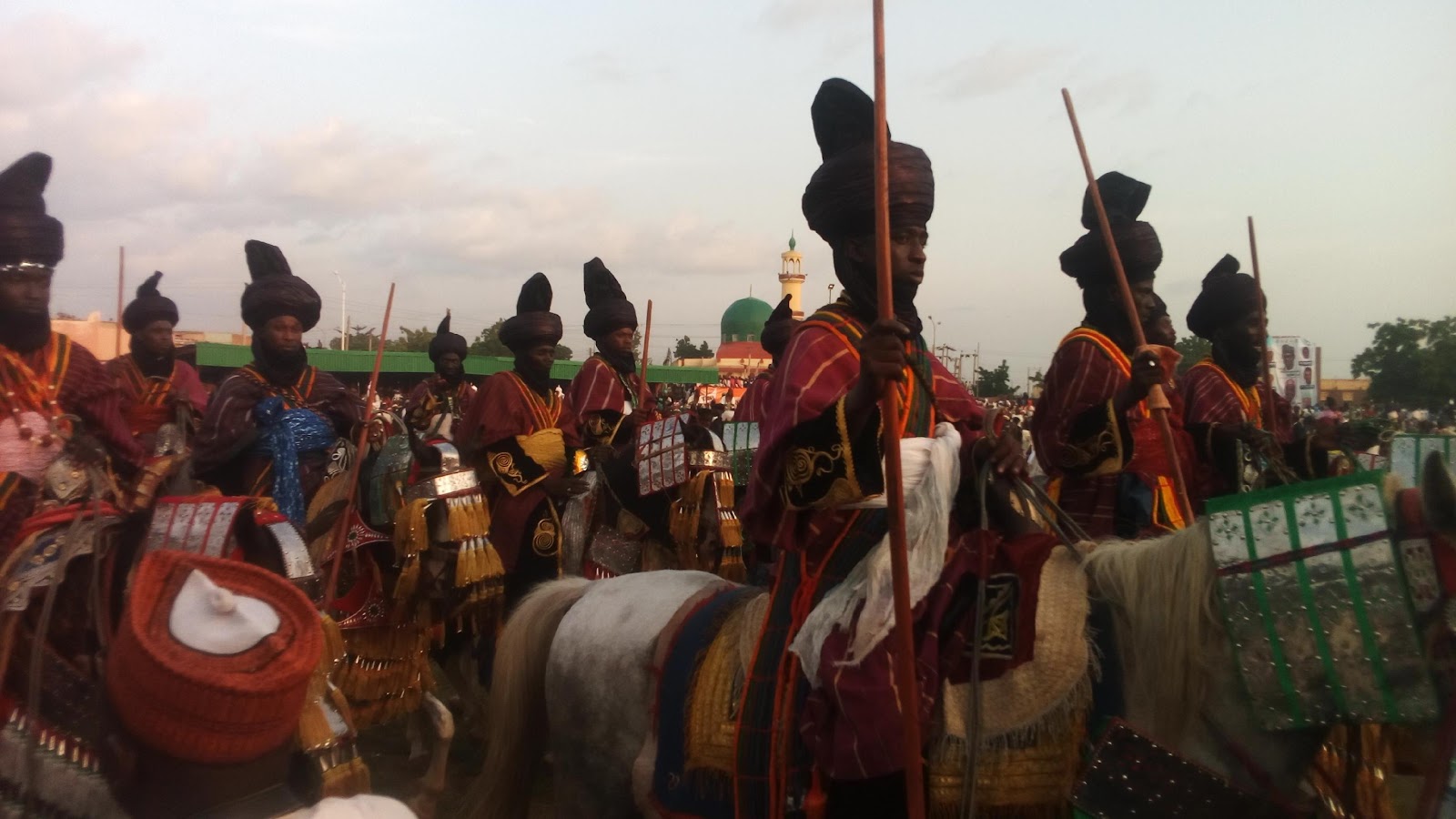
Horsemen at Daushe Durbar, 2017
If the familiar things of the home culture make people at home and connect their souls with the land, the rigidity of that settled culture can create an odd feeling of out of place. The Diaspora Nigerians may be washed in the deluge of homesickness. Watching the sounds and visions of homeland from elsewhere, Muhsin Ibrahim, who only two days away from Sallah had travelled to Germany, revealed in a Facebook update what it means to lose a day of the festivities; painfully, jeeringly, begging for innards. “Whoever leaves home, the home leaves him,” he posted on Sallah day.   
But Sallah festivities these seasons seemed to suffer certain bluntness, people weren’t typically in new clothes, a reason alluded to a medley of factors, including the effects of the current economic crunches and Boko Haram crisis. This catalogue of pressures overshadowed other sides of public lives, painting a drab and cheerless picture. “People sold food on Sallah day and returned to their daily life,” one local told me in a conversation.
Habiba Ahmad, a mother of four who by tradition used to host a small crowd of people annually at her home, had swum with the tide. Young men lurked around, walked in and out her home before finally leaving.  
Tonight, a day after Sallah, I met a group of young men, mostly college and university students, sitting front out of a printing studio with cups of black tea, chatting. Asked whether they slaughtered ram, they did not, none of them was married.
But that was not the entire reason. Hafizu Gambo Jibo, the owner of the printing business, a Bayero-University graduate, after earning a degree in Sociology in 2010, looked at the general situation in the country and made decision. Nasiru Abdullahi, a diploma holder in Mass Communication from Kano State Polytechnic, said Sallah has always been full of joy, but Musbahu Sa’id Bakin Ruwa, a petty trader in Kwari market, countered, “I am upside down.  I am thankful anyway, I am healthy.”
As meat became hard to come by, locals fell back on other delicacies, to blunt the effect of privation, this persistent yearning for something salty that rose at the hopeful expectation of something palatable which has seemed not be there. A distance further from the studio, a small crowd of men half-circled an awara seller. This was normal, they said, if it wasn’t Sallah times.
Although a lot more camels had been slaughtered than witnessed in recent years, it wasn’t a sign of growing prosperity.
“It’s fatter,” said Umar Hamza, a trader at animals’ market along Kabuga-Kofar Dawanau Road, one of the makeshift places that spring out every year across the Kano major streets. “You will get more meat at cheaper price than you have for a bull.”
Religiously people are enjoined to share with the needy. But if giving meat out is a sign of piety, some people can prove to be bad Muslims. That was not the case with Habiba’s family, for whom not cooking is not something so horrific. When I met her Habiba was besieged with activities; in ordinary clothes, blood-stained from the meat she had been preparing. Great part of it, she said, would go to the public.
Another family, and several more, had witnessed an awful spiral downward in their fortunes. The wife who spoke on condition of anonymity, in sobs and shedding tears, said that her husband maintained the habit of slaughtering animal for over thirty years of their marriage. It did not happen this year, and kept her the children indoor to protect them from the pain of seeing neighbors doing what used to be their culture. She wouldn’t let them out, to let them out, she said, is capable of creating the urge to beg, to ask and the shame for something strangely unusual.
To ask is to expose one’s pain. They were forced to do that, this and the year before, struggling for something more crucial than ram - food.
However, life is not entirely doomed for them. The children were scampering joyfully, collecting pieces of the skinned animal into the family compound, a sympathetic relative donated an animal to the family.
How people are able to rise above this paradoxical life, to get immersed in festivity amidst motley of pain and fear will be surprising to many. Food and social exchange, dress, cultural performances, and equestrian procession play key role in helping them bypassing their worries.
Life is an art, an art of resilience against fear and hopelessness and shared happiness. “It is a street party, with mom and dad and kids,” said Abdullah Uba Adamu in regard to Kano Durbar, professor of Hausa popular culture, media and communication from Bayero University Kano.
Carmen McCain, an American expatriate, recounting her experience of the Hawan Sallah, said she was struck by “the community feel of the activities.”
Happiness can take position where terror was once there. Near the Kano Grand Central Mosque, where in 2014, hundreds were killed and injured, cheerful crowd converged, some parched over the mosque’s fencing, some leaned on the wall, aged, young, men and women, to watch the emir’s procession. “It takes away all your tension, it entertains and makes you relaxed, forget all your worries.” Sani Kabir Idris said, who watches the Durbar annually.
Five days after Sallah, traffic at Zoo Road remained heavy, clogged with humans and vehicles. “We are no longer afraid, that’s why you see me here,” said a woman with a baby strapped to her back on queue at the gate of Shoprite, alluding to escalating security concerns that halted festivities in recent years. The woman, Binta Balarabe Sharada, with a baby and four children  waiting to enter the mall said she was there because security had improved tremendously.

Crowd at the gate of the shopping mall
Maryam Ahamed Sheka, who also  had to endure the seeming endless queue said “I am very happy.” She along several others would be searched by security men before being allowed into the ultra-modern shopping mall, named after the late emir Alh. (Dr) Ado Bayero.
Even as darkness was setting in, people seemed relentless to conquer the line that stretched far into the distance, wounding round the building. “I came here to shop and entertain myself with this,” Maryam pointed to the merry-go-round where dozens children were rolling.  

Heavy traffic at Zoo Road, near the shopping mall
Public transport was very hard during Sallah times. Coming from as far as Rijyar Lemo, people like Mubarak Abubakar could brave oddity and inconveniences that the transport and distance can pose.  Mubarak was boisterously chatting with two girls in front of the mall’s gate, one for him, the other for his friend, an added role that Sallah has for connecting love, boys meeting girls, even if for the few days.
But the cleanliness and prettiness of girls, the seeming open-handedness of boys, are a sham, many believed; a carefully planned, carefully orchestrated performance.  
Back at the Kano Grand Central Mosque, enchanted crowd watched in ecstasy, the passage of royal entourage, prefaced by thundering guns. Dressed in ostrich-feathered garments, smelly from long storage, were armed horsemen. The guards, famously called ‘Yan Lupudi, were at the front and the rear, the emir at the middle, actively protecting him, followed by about dozens vacant royal horses and camels.
The procession beat time with slow-paced traditional music in praise of the royalty. Various traditional instruments, some beaten, some shaken, some jingled, some blown and whistled, were used to produce sound of avalanche musics, of which royal foot-soldiers danced to.  Traditional title-holders were sung the praise of their titles and genealogy, an important marker for who they are in the palace.
Falakain Kano, a blood brother to Emir Muhammadu Sanusi II, passed with his men in white. The brothers, really look alike, no doubt; the blackness and skin texture, cylindrical frame of face and physique.
Locals waited in astounding suspense as the emir paused intermittently, in prayer and greeting, offering lifted fist in royal salute. The waiting, something that ideally supposed to annoy, delighted the crowd.
“The essence of Sallah is for the emir to meet his subjects” said Bashir Muhammad Inuwa, a great grandson to Kano royal family, “we are happy with the tradition of our family.”
As the procession moved on, multiple blast of gunshot erupted to signal the final arrival of the emir, a delight to many, fright to uninitiated. The royal guards charged in spirited galloping, into the race arena beside the Kano Grand Central Mosque, into the royal house to clear the way for the emir.
The emir, dressed in all-white: white turban, white amawali, white horse, white parasol with whitish Arabic attire famously called al-kyabba, trekked earlier on to the mosque in company of his subjects. He took position in the charged atmosphere to deliver his message after the gunshots had ended. Horse-riders and archers formed a pyramid around the emir, the emir at dignified centre end, watching the title-holders pay their homage, stars of lightning cameras flashing on him.